
Modern pharmaceutical, biotechnology, environmental, and quality control laboratories depend on accurate and reliable analytical data. To help ensure data integrity and regulatory compliance, HPLC systems should be qualified throughout their lifecycle according to established quality and regulatory practices.
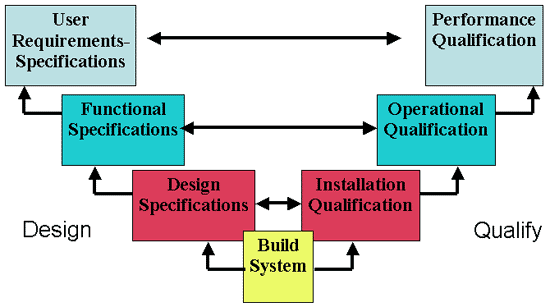
Instrument qualification is commonly divided into four stages:
- Design Qualification (DQ)
- Installation Qualification (IQ)
- Operational Qualification (OQ)
- Performance Qualification (PQ)
Together, these activities help demonstrate that an HPLC system is suitable for its intended use and continues to generate reliable analytical data.
What Is Design Qualification (DQ)?
Design Qualification confirms that the selected HPLC system is appropriate for the intended analytical application and laboratory requirements.
Typical considerations include:
- Instrument capabilities
- Detection requirements
- Regulatory requirements
- Laboratory workflow
- Software and data integrity needs
What Is Installation Qualification (IQ)?
Installation Qualification documents that the HPLC system has been properly delivered, installed, configured, and documented according to manufacturer specifications.
Typical IQ activities include:
- Instrument installation verification
- Hardware configuration documentation
- Software installation verification
- Utility verification
- Documentation review
What Is Operational Qualification (OQ)?
Operational Qualification verifies that individual instrument components perform according to manufacturer specifications.
Examples include:
- Autosampler volume accuracy
- Pump flow-rate accuracy
- Pump pressure testing
- Detector wavelength accuracy
- Column oven temperature accuracy
- Gradient proportioning accuracy
OQ is typically performed by trained service engineers, instrument vendors, or qualified in-house personnel.
What Is Performance Qualification (PQ)?
Performance Qualification verifies that the complete HPLC system performs reliably under actual laboratory operating conditions. Unlike OQ, which evaluates individual components, PQ evaluates the overall performance of the entire chromatographic system. PQ testing helps answer an important question:
Can this HPLC system produce accurate, reliable analytical data today?
Common PQ metrics include:
- Injection precision
- Retention-time precision
- Detector sensitivity
- Detector noise
- Carryover
- Gradient dwell volume
- Extra-column volume
- Flow-rate verification
- System suitability performance
Why Is PQ Different from IQ and OQ?
IQ and OQ primarily confirm that an instrument was properly installed and functions according to its design specifications. PQ demonstrates that the complete HPLC system performs acceptably for the laboratory's intended analytical use. This distinction is particularly important because two HPLC systems with identical model numbers may still produce different chromatographic results due to differences in:
- Detector performance
- Gradient dwell volume
- Extra-column dispersion
- Injector performance
- System plumbing configuration
- Maintenance history
When Should PQ Be Performed?
Performance Qualification is commonly performed:
- Every 6 to 12 months
- After preventive maintenance
- After repairs
- After software or hardware upgrades
- After moving an instrument
- During method transfer activities
- During troubleshooting investigations
Characteristics of a Good PQ Program
An effective PQ program should be:
- Scientifically valid
- NIST traceable
- Easy to perform
- Consistent and reproducible
- Well documented
- Instrument independent
- Suitable for comparison between laboratories
HSQ Kit for HPLC Performance Qualification
The MICROSOLV HSQ Kit provides standardized procedures, NIST-traceable reference materials, software tools, and documentation for evaluating HPLC system performance.
The kit is designed to help laboratories:
- Measure system sensitivity
- Evaluate detector performance
- Determine extra-column volume
- Measure gradient dwell volume
- Verify injection precision
- Evaluate carryover
- Support method transfer activities
- Document system performance over time
Why Compare Instrument Performance?
Even identical HPLC systems can produce different analytical results. The instrument comparison report shown below demonstrates how two HPLC systems of the same model and similar service history produced measurable differences in:
- Detector sensitivity
- Noise
- Limit of detection
- Retention-time precision
- Extra-column dispersion
- Dwell volume
These differences can influence method transfer success, system suitability results, and analytical performance. Routine PQ testing helps laboratories identify and document these differences before they affect regulated analytical work.
| Instrument: | Agilent 1100 LC System #9 | Agilent 1100 LC System #2 | |
|---|---|---|---|
| Performance Characteristic: | Test Conditions: | Performance: | Performance: |
| System Extra-Column Dispersion: | Rs test mix extrapolated N | 5 uL | 3 uL |
| Gradient Dwell Volume: | Dwell Volume: | 1.20 mL | 1.07 mL |
| Delivery Accuracy: | All circuits <5% of nominal | All circuits <5% of nominal | |
| % Injector Carryover: | No Wash Vial: | 0% | 0% |
| With Wash Vial: | 0% | 0% | |
| Injection Precision: | 10 replicate inj. | 0.07% RSD | 0.07% RSD |
| Ret. Time Precision: | 10 replicate inj. | 0.21% RSD | 0.06% RSD |
| System Sensitivity: | caffeine @ 273nm normalized for column efficiency peak to peak noise @ 273 nm | Sens. = 363.9 mAU/µg LOD = 0.032 µg/mL Noise = 0.04 mAU | Sens. = 400.6 mAU/µg LOD = 0.058 µg/mL Noise = 0.077 mAU |
| Pump Flow Rate Accuracy: | 0.5 mL/min | 100.3% | 100.0% |
| 1.0 mL/min | 100.3% | 100.3% | |
| 5.0 mL/min | 99.7% | 99.7% | |
| Pump Max Press: | BPR, leak check | Qual: to 5,000 psi, 345 bar | Qual: to 5,000 psi, 345 bar |
| Column Oven: | oven air temp<5°C of normal | Qual: 20-50°C, <5°C of normal | Qual: 20-50°C, <5°C of normal |
- View HSQ Kit Ordering Information
- Learn What the HSQ Kit Is
- View Sample HSQ Kit Test Results
- Download the Latest HSQ Kit Software